Sparkling Mindz
  • Home
  • School
    • Young Changemakers' Summit
    • Changemaker Missions >
      • SM Plates (Healthy Food Practices)
      • TRUI (Climate Change)
      • CSP (Community, Stories and Practices)
      • MCV (Mission Child Vulnerability)
    • Poetic Fete
    • Children as Changemakers in the City
  • Preschool
  • Programs
    • The Future of Education Summit 2025
    • Wizets
    • Child in the City Heritage Walks
    • Young Thinkers and Achievers
    • Early Learner's Enrichment
    • Summer Camps
  • Enquiry
  • Testimonials
  • Blog

'Something Else'

19/2/2020

Comments

 
What would you do if you ever felt like you weren't part of a group, that you had no friends, that you felt like nobody liked you? 

How would you feel? 

Moreover, how do you think a child feels when she feels like she has no friends, that she isall alone, that nobody likes her?

Our 4 year old K had been finding it difficult to connect and be friends with her classmates, feeling alone and sad but not sure how to solve it by herself; neither did she have clarity on why and what she was feeling. 

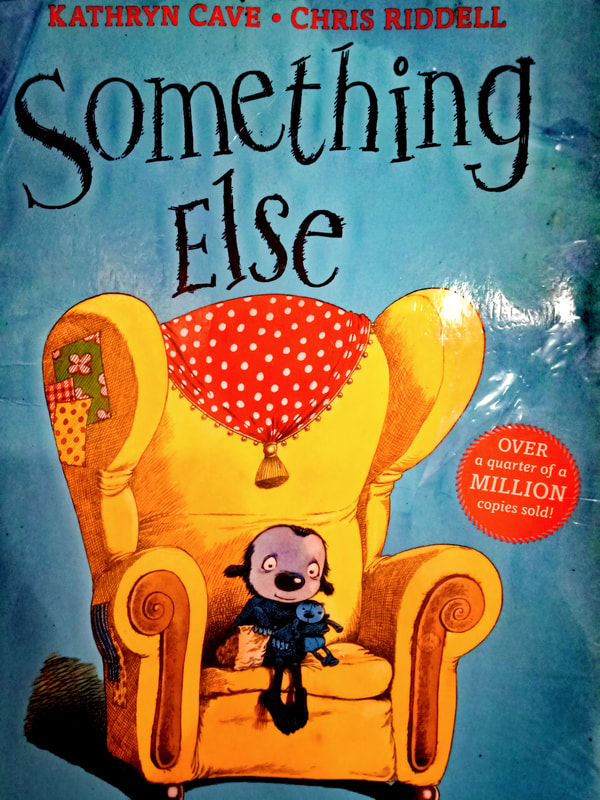
The time came then for our 4 year olds to get a new set of library books to take and read at home. Out of those books, was one tiny treasure called 'Something  Else' by Kathryn Cave and Chris Riddell. The book is about a little creature the other animals call 'Something Else' because it doesn't look like the others. The storyline moves through the emotions faced by the creature when it felt alone, sad, lonely because of how others treated it and called it 'Something Else'. The book however ends on a happy note where another creature that looks like none other comes into the picture and they become the best of friends. 

​
Picture

Call it luck, call it a connection, K found it and took it home for the week. Days pass by, the book made its rounds with the others without any of us realizing how deep a connection K had made with the creature in the book called 'Something Else', until it was brought to our attention by her mother. K had been feeling like she was Something Else in the class as she felt alone, lonely and sad. Reading that book gave her the vocabulary and understanding of her emotions and feelings that she connected to, resulting in her opening up about it to her parents. 

When it was brought to the attention of the school, we decided to dive right in, as we always do. With her in particular, we have been working on communication skills, and as a class, social skills and making friends with new children were on the focus. Because of the initial layer of work that was already done, when K's emotions were brought in the picture, children found it easier to empathize and suggest solutions.

We read the book today, it being a Thursday where we usually read a book for our Library Routine. We chose 'Something Else' to read and everybody was excited and jumping on their mats, except for K. She looked quiet and withdrawn throughout. However, we proceeded. Children kept empathizing with the character and vocalizing about the scenes in the book. Post the reading session, the floor was open for questions and further discussions. 

"Have you ever felt like how 'Something Else' was feeling? " 

Nobody answered as such. 

The question then was repeated to K to which she whispered a yes. She then came and stood with us in the front for the issue to be discussed further. We held her throughout to let her know that she was safe in our circle. 

"Because I am alone like Something Else. Nobody is not playing with me." meaning to say that nobody played with her.

The whole class of the 4-year olds sat quiet and looked concerned as she spoke as they now knew exactly how she felt. 

"We will be friends with you. " 
"We will play with you." 
"I will write a letter for you at my home. I will bring it for you. You can take it home."
"I will play with you K"...

And on and on went children, soothing her heart. 

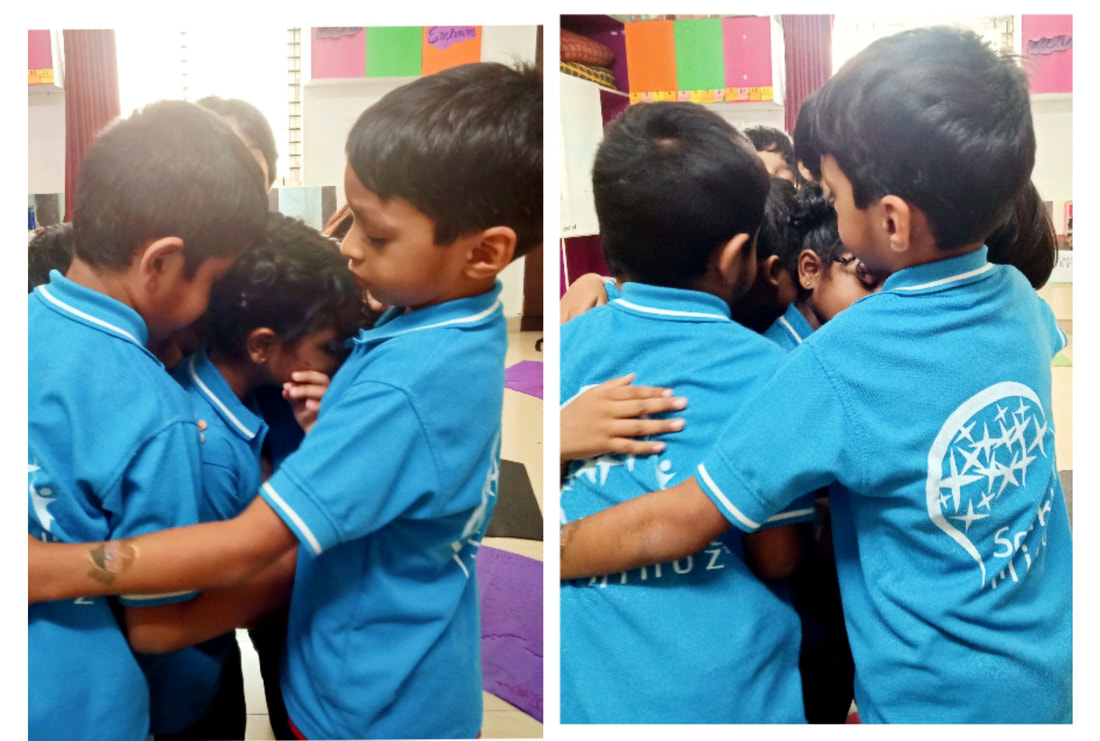
There was no need of further conversations and this culminated in a a gentle group hug where they just held her. And T planted her a kiss in the end. ​
Picture
Developing a vocabulary to express how they are feeling is a good first step to seeking help when someone is feeling left out, lonely or upset. Children, when not felt supported and loved, can develop all kinds of insecurities right from childhood that could take a long time to move out of. As important as it is to make them feel loved, supported and belonged, it's also important equip them to love, support and be there for one another. 


Contributed by Sruthy Krishna, Learning Facilitator at Sparkling Mindz Global Preschool.

Comments

"School is so boring!", a hidden perspective

7/2/2020

Comments

 
The day for the 3 to 4 year olds had just begun where they all sat down after the Welcome Song. Since the new academic year has just been kick started, they were all pondering on the new things they were about to learn this year, things that they remember from last year, etc. 
They are currently in Cubs (3-4 years). The hierarchy at SM goes like this, 
Guppies, Pups, Calves, Cubs, Joeys, Dolphins, Leopards, Falcons and Unicorns (from 1.5 year olds to 18year olds) and An seemed curious. 

An: What is after Joeys, ma'am?
Facilitator (F): Dolphins. 
An: And then?
F: Then we have Leopards, Falcons and Unicorns.
Av: They are all animal names. 
F: Yes, absolutely!
An, not having registered Av's comment continues: It will take us a long time to get there. 
F: Yeah, a few years. Which is awesome because you will get to learn so much and have so much fun doing it too!!
An, looking like she's given up: Ahh, so tiring ma'am. We'll be so tired by then. 
F: What do you mean?
An: School is so boring ma'am. All these letters and numbers and activities. I don't want to come. 
F: Why do you feel like that? Because the An that I know loves to come and learn things. 
An (nodding a clear no): No I don't. I don't want to learn any of these. They are boring. I get so tired. It's so tiring. 

An has been visibly quite off since the morning, so the Facilitator asked her a couple more questions, which seemed to just go in the loops of 'tiring' and 'boring' and an overall 'quitting' mode. 

F: Are you really bored and tired, or are you just having a bad day?
An (suddenly sitting up, giving it a second to think, seemingly more clear in her thoughts now): I'm just having a bad day. 
F: What happened?
An: I didn't sleep well. I woke up to drink water. 

Then she was taken through the loops she had created in her head which connected school and her overall energy for that day, and given more clarity which she then agreed to that they were two separate things after all.
​
F: So you're saying you didn't sleep well and woke up at night and you're tired because of that?
An nods in agreement.
F: Does it still mean that you consider school boring and tiring? And you don't like the activities?
An: No I think I am just tired today. 
F: okay. See you just mixed it here. You were feeling tired because you didn't sleep well and you thought you didn't like school because of how tired you felt. See these two are not connected. 
An nodding in agreement: Yeah. 

She seemed to have resolved that little loop she had created and the rest of the day went by smooth for her and her energy seemed high too. 

It's important to help children see perspective and let them talk and figure things out for themselves without jumping in and resolving things immediately. Understanding their thought patterns and going deeper is essential to resolve conflicts and move ahead. What happened with this 4 year old was an important lesson for the child and the rest of the children who were listening to this conversation because it helped them see perspective and probably resolve things quicker later. 


Contributed by Sruthy Krishna, Learning Facilitator at Sparkling Mindz Global Preschool.
Comments

Are Children Colouring Books?

3/2/2020

Comments

 
Picture
"Children aren't coloring books. You don't get to fill them with your favorite colors.”

Our morning inspirational stand up today was inspired by this quote by the author Khaled Hosseini. We thought about how we might interpret this and take it forward.

We were trying to think of the very many connotations this powerful line could have. First, we spoke about how, just because we have colours and just because we think children are empty books, we may feel the need to fill them up. But can we resist that urge and work on our belief instead?

Could we try and find other means to actualize our impulse to colour and create? For, our children are neither our work of art nor our trophies to display on the mantelpiece. They are living, breathing, growing, changing beings who have their own journeys to create.

Where does this urge to fill up colours come from? And not just colours but our favourite colours. What happens when we fill our children with our favourite colours? They start to look just like (and ONLY like) our favourite colours. What about the entire spectrum? Do we know the entire spectrum ourselves? And even if we don’t, do we want our children to know them, experience them and colour their lives with the entire range of possibilities?

What about the fact that we are coloured books ourselves and we can’t help colouring (or influencing) others. The mere act of being becomes an act of colouring. We are bound to at least ‘impress’, if not consciously 'colour'. How can we help this? One way to minimize the effect is to be aware of our colours ourselves and to know how these colours would or could interact with other colours, and with blankness. Some colours are darker than others, some stronger. Once we can know and see ourselves for the colouring books we are, we can begin to take steps to add new pages to this book…

Once we realise that we are coloured books, we might also realise how we need not have been. And perhaps, our children need not be either. Because if our children are colouring books, then even if we do not fill them in with our favourite colours, someone or something else might. What if we were to not think of our children as colouring books or blank slates but instead as seeds…which have lives of their own? 


Contributed by Poorva Agarwal, Assistant Learning Facilitator at Sparkling Mindz Global inspired by an inspiration standup that happened at school in the morning of 21st Jan 2020.

​
#sparklingmindzglobalschool
#inspiringconfidentlearners
#youngachieversacademy
#21stcenturylearning
#everychildcan
#socialemotionallearning


Comments

Work life balance - From what I thought it was to what it actually is!

29/12/2019

Comments

 
Picture

From employers constantly struggling to provide it to their employees to the employees constantly striving to achieve it, ‘Work-life balance’ has been a critical concept ever since it’s conception in 1986 and even before. Companies have been working rigorously to reform and re-formulate employee friendly policies while employees religiously promise themselves to leave work on time and spend more time with their families, but in vain.

Ever since I heard the term ‘Work-life balance’, even before I began working, I had decided to have one for myself and here is what I did to achieve it.
1. Carry a straight face to work.
2. Avoid unnecessary interactions (I’m here to work and not to make friends).
3. Focus on assigned tasks and deadlines.
4. Leave work on time without carrying work home.
5. When away from work, passively worry about the challenges that might show up at work the next day or the coming days and make mental strategies to escape them.
By now, you would have already figured out that this epic strategy of mine massively succeeded at failing me! Neither did I have any kind of job satisfaction nor a peaceful life. Work for me was a means to earn money to do things that I loved and the things that I loved stopped bringing me joy as my mind was always pre-occupied with the fears related to work. This lead me to switch multiple jobs unsure of what I was really looking for until I landed at my current job as a Pre-school facilitator.

So what is this “Work-life balance” and how do we achieve it?
A few months into my job as a Pre-school facilitator, I learn’t that there is nothing called “managing work and life”, it’s all about “Managing yourself”. A few perspective changes was all I needed to do to achieve it.
1. There is always time for everything we love or we can always make time if we want to, all we need to do is completely be present while we do it. It’s better to spend half and hour with your family with no distractions than an entire day where you are constantly on calls or fiddling with your phone.
2. Be your authentic self, the energy and will power that you use to carry a facade can be used to be more productive. Your creative self is at it’s best when you don’t fear judgments.
3. Find a larger purpose in everything you do, a lack of strong purpose deprives you of satisfaction.
4. Look at challenges as an opportunity to learn instead of getting overwhelmed by them. Say “Hmmm interesting! How do I figure this out?” instead of “Sh*t!!”.
5. Resolve conflicts and emotions as and when they emerge. The people who love you or work with you, don’t deserve to handle emotions that you dump on them because you chose to not resolve them.

Although this seems very simple, when put into practice needs a lot of effort and it’s a constant process. But it’s also true that, nothing worth having comes easy. If you really want to live a great life, you will put in that effort to make it happen.

In conclusion, I would like to express my immense gratitude to my mentor for his time and patience while I figured things out and my colleagues for their humble support. I feel extremely privileged to have arrived at where I am today and I still have a long way to go.

​Contributed by Yashika CG, Facilitator, Sparkling Mindz Global Preschool
Comments

Preschoolers learn to solve own problems: Day 2

5/12/2019

Comments

 
Yet another conflict comes up in the 3 and 4 year olds' class today. This is what happened,

T is visibly upset and is stamping on the floor in anger and tears in her eyes. 
F: What happened? 
She gives no response. After a few moments, she says, "A is not my friend!" 
To which A said with a surprised expression, "That's not true. I am."
T seems surprised. But still crying. 
Suddenly, A jumps in to explain, "She hurt me."
T calmed down and said, "But I said sorry."
"No, she didn't!", said A, defending herself. 
"I said it very softly but", T explained, and stomped off to the corner to cry saying, "I am very upset!" 

Now everybody in the class is quiet and watching the entire thing. 

H and A were sitting next to each other at this point. Suddenly H stands up for the situation, feeling responsible, and tells A, "A get up and go talk to her."

A follows suit. She goes to T and gently tells her, "You say sorry to me."
T doesn't budge. After a few seconds of trials, A looks around and calls everybody to them. Without any more intervention from A, everybody gravitates towards them both and hugs T as a way of consoling her post which T flashed everybody the widest smile. She said sorry to A after this and the entire problem was solved.

When children are shown how problems are solved, they naturally start picking up the habit and show problem solving skills even at the youngest age of 4. When trust is established with them that they are capable individuals who can solve their problems, they reach a whole new level of confidence in themselves with the belief that they are capable of solving their own problems.  They, then show us what anger, crying, distrust and fear can't do - a little bit of love can magically solve!

Contributed by Sruthy Krishna, Learning Facilitator at Sparkling Mindz Global Preschool.

#sparklingmindzglobalschool
#inspiringconfidentlearners
#youngachieversacademy
#everychildcansolveproblems
Comments

The Red Chair Problem - A Documentation

3/12/2019

Comments

 
​It was around 10:20am and our 4-5 year olds were setting their class up for snacks. Just then, the facilitator spotted Ad and Sh fighting for the red chair. The class had just one red chair and this was not the first time children were fighting over it. The facilitator intervenes and takes away the red chair from both of them.
 
F: Okay! Looks like we have a very serious problem.
Ab: Because of all of us!
F: What do we now? There is just one red chair and so many of us want to sit on that one chair.
Ash: I’m sitting on a yellow chair, Everyday I’m sitting on different, different chair.
F: People sitting on different chairs everyday, that’s great! Now, how can we solve this red chair problem?
Ab: No red chair (He meant, taking away the red chair)
(Ad, visibly very upset, takes a chair and sits away from the circle, making angry gestures.)
F: (To the class) Ad will calm down and tell us how he wants to solve this problem.
 
F (now addressing the whole class): Do you all have any suggestion for Ad?
Sh: I have! Maybe he can say sorry to the red chair and not fight with the red chair.
F: Was he fighting with the red chair or was he fighting for the red chair?
Ab: He was fighting for the red chair.
Ar (Raises his hand): Take away the red chair!
An: He can take the chair some of the days, he cannot take the chair tomorrow.
F: So you are saying, Ad can take the chair on some days and some days he can give it to others?
Ab: I have a solution, we can paint the red chair in different colors.
Ash (Interrupts): If we paint the red chair, all the paints will be over.
Ab: We can stick paper on the red chair and paint the paper.
F: Hmmm… Ad loves the red chair, if we change it to another color, would that solve the problem?
M: We all love the red chair. All of us love all the chairs.
F (To Av): Do you have a solution?
Av: The solution is when Ad is going to take the red chair, somebody else should take the red chair.
F: Do you think Ad will like it?
Av: If Ad wants red chair, we can just cover it with white.
F: How will that solve the problem? He still loves the red chair isn’t it?
Ab: Maybe we can get more red chairs.
Ta: Ma’am, I’ll give my red chair to Ad and take a different one.
F: You could do that, but Ad likes only that Red chair (The bright one).
Sh: Ma’am, all the other chairs are saying we love Ad.
Ad (still angry): (makes roaring noise)
T: Maybe I’ll tell everyone that Ad wants the red chair and please can you let him take the red chair?
F: Do you think it’s fair to let Ad take the Red chair everyday? Sh also likes the Red chair and she also wants to sit on it sometime.
T: Maybe, you can let him take the Red chair today.
F: OK, how about we agree on An’s idea? She said Ad can take it some days and give it to others on some days, Would that work with you Ad?
Ad: Today I’ll take it, tomorrow I’ll give it.
T: Maybe Sh and Ad can keep on exchanging.
An (Raising her hand): I should also get it.
 
Everybody else in class also started raising their hands one by one saying “I also want the Red chair”, and we decided to make a timetable and put it up in class so that everybody gets to sit on the red chair. Ever since then, there has not been a conflict regarding the Red chair.
 
Taking away the red chair would have easily solved the problem but that would have been momentary and would have robed the opportunity form children to discuss and arrive at a solution. Here, they not only displayed their reasoning and problem solving capabilities but also, in the process felt that their voices mattered. Encouraging or involving children in decision making and problem solving will help them build trust in themselves as well as creates a sense of ownership as the child feels understood and listened to. 

Contributed by Yashika CG, Learning Facilitator, Sparkling Mindz Global Preschool

#sparklingmindzglobalschool
#inspiringconfidentlearners
#youngachieversacademy
#everychildcan
Comments

Empathy as a culture - a documentation

2/12/2019

Comments

 
​During a story reading session with 5 year olds, children were feeling hot and wanted to turn on the fan. Ar and Av get up from their chair and run towards the switchboard at the same time. Av reaches first and turns on the fan and as an instant reaction Ar hits him.
 
(Facilitator (F) observing the scene calls out for them)
 
Av: Ma'am Ar hit me, he always hits me.
F(to the class): Do you all think Ar gets angry and hits people for no reason?
Class: No ma'am. 
Ar (angrily): I get angry when people don't let me do what I want to do.
F: I understand you get angry but, is it helpful to hit or hurt someone when you are angry?
Ar: Yes 
F (to the class): Do you all think hitting when angry is a good thing?
Class: No ma'am. 
T: Ar should talk to them.
F: Thank you T, do we all want to help Ar calm down when he is angry? 
Class: Yes ma'am.
F (to Ar): How do you want everyone to help you calm down?
Ar: By not talking.
F (To the class): So, can we all agree to not talk to Ar when he is angry, he'll calm himself down and then join us.
Class: Yes ma'am.
F (to Av): Why do you think Ar hit you?
Av: Because I saw Ar run and I ran before him and turned on the fan.
F: What do you think you could have done instead?
Av: Let him (switch) on the fan, next time I will get a chance.
F (to Ar): What do you think you could have done?
Ar: Ask him.
F: So, do we all agree to use our words next time we don't like something?
Class: Yes ma'am.
 
Be it a child or an adult, helping them become aware of their own emotions and learning to express them in resourceful manner is a very important skill to learn for life. When children start this early, it helps them empathize with themselves and figure out mechanisms to understand, accept and cope with their emotions better, building emotionally resilient adults of the future. 

Contributed by Yashika Ganesh, Learning Facilitator, Sparkling Mindz Global Preschool and edited by Sreeja Iyer, CEO, Sparkling Mindz.
​
#sparklingmindzglobalschool
#inspiringconfidentlearners
#youngachieversacademy
#everychildcanempathize
Comments

Learning to love myself...

1/11/2019

Comments

 
It is the Poetic Soiree season and like you rightly can guess, Poetry is in the air. Unlike, other times, we have inspired poetry and children's own poetry being shared. As children express themselves, some of their innermost thoughts and struggles resonate. They are all learning to love themselves and not get influenced by other's opinion of themselves. 

Children very easily get influenced by what their friends think or say about them. They easily internalize negative messages about themselves  and make it their own. 

We have been talking to children about their internal voice and keeping it positive. Sharing a poem I wrote based on the inspiration.  This has been an ongoing process for us, so this poem was written in Aug 2017.

-When I love myself--

When I'm harsh on myself
I can't see anything good
When I love myself
I'm okay even if they're rude

When I judge myself
Every finger points at me
When I love myself
They are just being free

When I criticise myself
I lose the will to fight
When I love myself
I gather all my might

When I look for flaws in myself
I stare down a deep, dark hole
When I love myself
I find ways to make myself whole

When I don't trust myself
I get angry at all my mistakes
When I love myself
I'll learn and up my stakes

When I care too much
About what others will think
I lose sight of what I hold dear
And what I value in the fear

When I live in fear
Of being found
For the fraud I'm
I cry, I run, I hide

When I live in joy
Of discovering
Who I'm
I stay, I learn, I grow

--Sreeja Iyer
CEO, Sparkling Mindz 

#sparklingmindzglobalschool
#inspiringconfidentlearners
#youngachieversacademy
#poemforthesoul
​#growthmindset
Comments
Forward>>

    RSS Feed

    RSS Feed​

    Sparkling Mindz is an organization with a vision to create millions of confident thinkers and communicators amongst our children!

    ​You can read more on...

    CEO's FB Page

    Archives

    June 2025
    May 2025
    March 2025
    February 2025
    January 2025
    December 2024
    November 2024
    October 2024
    August 2024
    July 2024
    June 2024
    April 2024
    February 2024
    January 2024
    December 2023
    October 2023
    June 2023
    April 2023
    March 2023
    December 2022
    October 2022
    September 2022
    August 2022
    June 2022
    May 2022
    April 2022
    March 2022
    February 2022
    January 2022
    December 2021
    November 2021
    August 2021
    July 2021
    June 2021
    May 2021
    April 2021
    March 2021
    February 2021
    January 2021
    December 2020
    November 2020
    October 2020
    September 2020
    August 2020
    July 2020
    June 2020
    May 2020
    April 2020
    March 2020
    February 2020
    January 2020
    December 2019
    November 2019
    October 2019
    September 2019
    May 2019
    April 2019
    March 2019
    February 2019
    December 2018
    July 2017
    June 2017
    June 2016
    May 2016
    April 2016
    September 2015
    May 2015
    April 2015
    January 2015
    July 2014
    April 2014
    February 2014
    December 2013
    November 2013
    October 2013
    September 2013
    January 2013
    November 2012
    October 2012
    August 2012
    June 2012
    March 2012
    February 2012
    December 2011
    November 2011
    October 2011
    September 2011
    July 2011
    June 2011
    May 2011
    April 2011
    March 2011
    February 2011

    Categories

    All
    21
    21stcenturylearning
    2 Year Olds
    3 Year Olds
    4 Year Olds
    4-year-olds
    5 7 Year Olds
    5-7 Year Olds
    5 Year Olds
    5-year Olds
    8 13 Years
    8-13 Years
    Activity Modules
    Add
    Adhd
    Afterschool Program
    Age Appropriate Session
    Age-appropriate Session
    Age Group
    Awards And Recognition
    Bangalore
    Being Changemakers
    Book Reading
    Child Development
    Children Making Friends
    Children's Activities
    Children's Workshop
    Children's Workshops
    Collaboration
    Communication Skills
    Communication Skills Workshop
    Community
    Concluding Sessions
    Confidence
    Confident Learners
    Confident Thinkers
    Conflict Management
    Conscious Parenting
    Creative Individuals
    Creative Thinking
    Creative Thinking For Kids
    Creative Thinking Summer Camp
    Creative Thinking Summer Camps
    Creative Thinking Tools
    Creative Thinking Workshop
    Creative Thinking Workshops
    Creativity
    Creativity For Children
    Critical Thinking
    Critical Thinking Workshop
    Curiosity
    Deep Learning
    Deep Thinking
    Dep
    Developing Creativity
    Distracted Behavior
    Documentation
    E
    Emergent Curriculum
    Emergent Play
    Emotional Quotient
    Emotional Vocabulary
    Emotions In Learning
    Empathy
    Everychildcan
    Experimenting
    Exploring Emotions
    Facilitation
    Facilitator Discussion Diaries
    Flexibility
    Flexible Brain
    Following Your Passion
    Fun Activities
    Fun Activities For Children
    Fun Modules
    Fun Places For Children
    Game Based Learning
    Games For Kids
    Getting A Quiet Child To Talk
    Growth Mindset
    Holistic Development
    Hyperactivity
    Imagination
    Imagining-with-blocks
    Impulsivity
    Innovative Learning
    Innovators
    Inquisitive Children
    Inspiration
    Inspirational Stand Up
    Inspiring Confident Communicators
    Inspiring Confident Learners
    Interpersonal Skills
    Invitation To Play
    Joy
    Joyous Learning
    Just Books
    Keys To Success
    Kindness
    Lateral Thinking
    Learning For Keeps
    Learning From Play
    Learning Styles
    Learning To Make Friends
    Light Play
    Logical Reasoning
    Making Connections
    Motivation Skills
    Music
    Natural Things
    Nature Of Creativity
    Nature Walk
    New Age Classrooms
    Open Ended Thinking
    Openness To New Expeiences
    Ownership In Children
    Parenting As A Skill
    Parent Invites
    Parent Testimonials
    Parent Workshop
    Peer Intervention
    Play Based Learning
    Playschool
    Poem For Children
    Poem For Children 8+ Years
    Positive Attitude
    Preschool
    Preschool Activities
    Preschool Games
    Preschoollibraryactivity
    Pretend Play
    Problem Solving
    Programs For Children
    Reframing
    Regg
    Reggio Documentation
    Reggio Emilia Inspired Preschool
    Reggio-emilia Inspired Preschool
    Reggio Emilia Inspired Preschool India
    Reggio-emilia Inspired Preschool India
    Reggio Emilia Inspired School
    Reggio Emilia Preschool Bangalore
    Resolving Disputes
    Resolving Fights Amongst Children
    Role Plays
    Self Expression
    Self Identity
    Self-identity
    Self Learning
    Self-learning
    Selflove
    Sensory Play
    Shy Child
    Shy Child To Talk
    Skills
    Social Emotional Learning
    Social-emotional Learning
    Sparkling Mindz
    Sparkling Mindz Stories
    Sports
    Stories
    Story Telling
    Story-telling
    Success Stories
    Summer Camp
    Summer Camp 2012
    Summer Camps
    Takehome
    Team Work
    Thinkers
    Thinking
    Thinking As A Habit
    Thinking As A Process
    Thinking Corner
    Thinking Program
    Thinking Skill
    Thinking Skills
    Thinking Skills For Children
    Thinking Skills Program
    Tinkering
    Traditional-classroom
    Trust Based Parenting
    Understanding-children
    Value Based Learning
    Visit To Park
    Visualization
    Weekend Activities For Children
    Wittyconversations
    Wonder Based Learning
    Workshop For Kids
    Workshops For Children
    Workshops For Kids
    Young Achievers Academy
    Young Thinkers Academy


Locations
Hennur - 8/4, Kannuru, Bidarahalli Hobli, Hennur-Bagalur Road, Bangalore 562149
Kalyan Nagar - 408, 2nd Floor, 5th Main, HRBR Layout 2nd Block, Kalyan Nagar, Bangalore - 43

Contact Details
Mobile: +91 9900080331

                 +91 9900080332
Phone: +91 80 4111 5607
Email: [email protected]

Company

About Us
Team
​
Child-Led Missions
Careers
Media

Support

Contact
FAQ
Terms of Use
​Privacy Policy
© COPYRIGHT 2011-2026 AVIDA EDUCATIONAL TRUST.